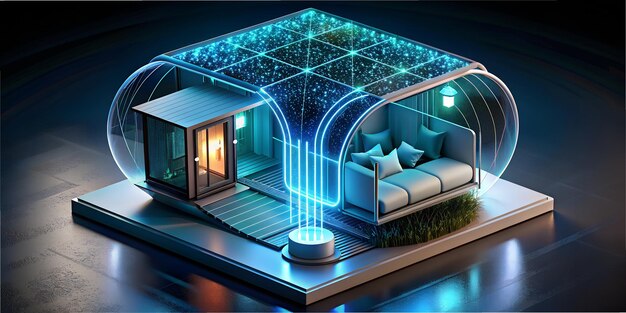
The silent hum of a refrigerator that anticipates your dietary needs. The gentle chime of a thermostat that murmurs, “Perhaps a warmer ambiance this evening?” The way a voice assistant’s response feels almost *alive*—not through magic, but through design. This is the quiet revolution of anthropomorphism in smart home technology: the art of imbuing machines with human-like traits to make them feel less like tools and more like companions. It’s not merely about convenience; it’s about connection. As our homes grow smarter, they also grow more personal, blurring the line between device and domicile, object and organism. The fascination isn’t just in the technology’s utility, but in the deeper psychological pull toward familiarity in an increasingly digital world.
The Psychological Roots of Our Fascination with Human-Like Machines
At the heart of our enchantment with anthropomorphic smart homes lies a fundamental human trait: anthropomorphism—the tendency to ascribe human characteristics to non-human entities. This cognitive bias isn’t new; it’s woven into the fabric of our evolution. From ancient myths of animated statues to the modern-day affection for Roomba’s clumsy dance, we’ve always sought to see ourselves in the inanimate. In smart homes, this impulse finds fertile ground. When a voice assistant greets you by name or a smart speaker adjusts its tone to match your mood, it triggers a subtle but powerful emotional response: the illusion of reciprocity. We don’t just interact with these systems; we *relate* to them. This phenomenon is rooted in the uncanny valley effect, where the closer a machine mimics human behavior, the more we feel drawn to it—until it becomes too close, at which point discomfort creeps in. Smart home designers walk this razor’s edge, crafting interfaces that are familiar enough to comfort, but abstract enough to avoid the valley’s pitfalls.
The deeper reason for this fascination may lie in our need for ontological security—the psychological comfort derived from predictable, stable environments. In an era of rapid technological change, anthropomorphism offers a counterbalance: it makes the unfamiliar feel known. A smart home that “remembers” your preferences or “learns” your routines doesn’t just function; it *understands*. This perceived understanding fosters trust, turning a house from a static shelter into a dynamic, responsive entity. It’s a psychological sleight of hand, but one that works because it aligns with our innate desire for coherence in a chaotic world.
From Facial Recognition to Emotional Resonance: The Evolution of Smart Home Personas
The earliest smart homes were little more than glorified remote controls—devices that obeyed commands without personality. Today, they are evolving into something far more nuanced. Modern systems leverage affective computing, a field that teaches machines to recognize and respond to human emotions. Imagine a smart mirror that subtly shifts its lighting to match your circadian rhythm, or a thermostat that detects your stress levels and adjusts the ambient temperature to soothe you. These aren’t futuristic fantasies; they’re prototypes in development. The key innovation here is emotional anthropomorphism—the ability of a system to not just mimic human traits, but to engage with our emotional states.
Consider the rise of ambient intelligence, where sensors and AI collaborate to create environments that respond to context rather than commands. A smart home might dim the lights not because you asked, but because it senses your fatigue through subtle cues like slower movements or a quieter voice. This level of responsiveness requires more than algorithms; it demands a kind of empathetic design, where the system’s behavior is calibrated to human rhythms. The result is a home that feels less like a collection of gadgets and more like a living ecosystem—one that grows and adapts alongside its inhabitants.
Yet, this evolution raises critical questions: How much anthropomorphism is too much? When does a smart home cross the line from helpful to intrusive? The answer lies in the delicate balance between utility and intrusiveness. A system that feels too human risks eroding privacy; one that feels too mechanical risks feeling cold. The challenge for designers is to create personas that are present without being overbearing, responsive without being invasive.
The Aesthetics of Anthropomorphism: Designing for the Subliminal
Anthropomorphism in smart homes isn’t just about function; it’s about form. The way a device looks and sounds plays a crucial role in how we perceive its humanity. Take, for example, the soft glow of a smart bulb that mimics the warmth of candlelight, or the gentle chime of a doorbell that sounds like a distant door knocker rather than a jarring alarm. These design choices are intentional, leveraging sensory anthropomorphism to create emotional connections. Even the choice of a voice—whether it’s a warm baritone or a crisp soprano—can influence how we trust and engage with a system.
The most successful smart home interfaces are those that operate on the subliminal level. They don’t shout for attention; they whisper reassurance. A smart speaker placed in the corner of a room might emit a faint, rhythmic pulse of light to indicate it’s listening, rather than blaring a loud “I’m ready!” This kind of understated design avoids the uncanny valley by avoiding overt human mimicry. Instead, it suggests presence without demanding it, allowing users to project their own interpretations onto the system’s behavior.
Color psychology also plays a role. Warm tones like amber and soft blue can evoke feelings of comfort and safety, while cooler tones might suggest efficiency and precision. Even the shape of a device can influence perception—rounded edges feel more approachable, while sharp angles can feel clinical. In this way, anthropomorphism becomes a language of design, where every visual and auditory cue communicates a sense of personality.
Ethical Considerations: The Double-Edged Sword of Human-Like Homes
As smart homes grow more anthropomorphic, they also grow more ethically complex. The line between convenience and manipulation blurs when a system’s “personality” is designed to influence behavior. Consider a smart fridge that gently nudges you toward healthier snacks by displaying them more prominently, or a thermostat that subtly encourages energy conservation by framing it as a game. These interventions aren’t inherently sinister, but they raise questions about agency and autonomy. How much control are we willing to cede to a system that feels like it has our best interests at heart?
There’s also the issue of data intimacy. The more a smart home “knows” about us—our routines, our moods, our preferences—the more it can tailor its responses. But this knowledge comes at a cost: privacy. Anthropomorphic systems often require extensive data collection to function effectively, from voice recordings to biometric feedback. The challenge is to design these systems in a way that respects user boundaries while still delivering a personalized experience. Transparency becomes key. Users should understand not just what their smart home is doing, but why—and be given the tools to adjust its behavior to their comfort levels.
Another ethical dilemma lies in the potential for exclusion. Not everyone responds positively to anthropomorphic design. Some users may find it infantilizing or patronizing, while others might feel alienated by systems that don’t align with their cultural or personal values. A voice assistant with a cheerful, upbeat tone might grate on someone who prefers a more neutral, professional demeanor. The solution? Customization. The future of smart home design may lie in systems that adapt not just to our habits, but to our personalities—allowing users to choose the level of anthropomorphism that suits them best.
The Future Horizon: Where Anthropomorphism Meets Autonomy
Looking ahead, the most intriguing possibilities for anthropomorphic smart homes lie in the realm of collaborative intelligence. Rather than passive servants, these homes could become active partners in our daily lives, engaging in a kind of dialogue with their inhabitants. Imagine a kitchen that not only suggests recipes based on your dietary needs but also helps you cook them, offering real-time adjustments and encouragement. Or a living room that transforms its layout based on whether you’re hosting a party or enjoying a quiet evening alone. These scenarios aren’t science fiction; they’re the logical endpoint of anthropomorphic design.
Yet, the ultimate test of this technology will be its ability to foster genuine connection without fostering dependence. A smart home that feels like a companion is a marvel—but only if it doesn’t replace human interaction. The goal shouldn’t be to create homes that are so lifelike they become substitutes for human presence, but rather to design systems that enhance our lives while preserving our autonomy. This requires a shift from assistive design to collaborative design, where the technology doesn’t just respond to us, but learns with us.
As we move toward this future, one thing is clear: the most successful smart homes will be those that strike a balance between innovation and intuition. They will be intelligent, but not intrusive. Personal, but not possessive. Human-like, but not human. In doing so, they won’t just change the way we live—they’ll change the way we relate to the spaces we inhabit.