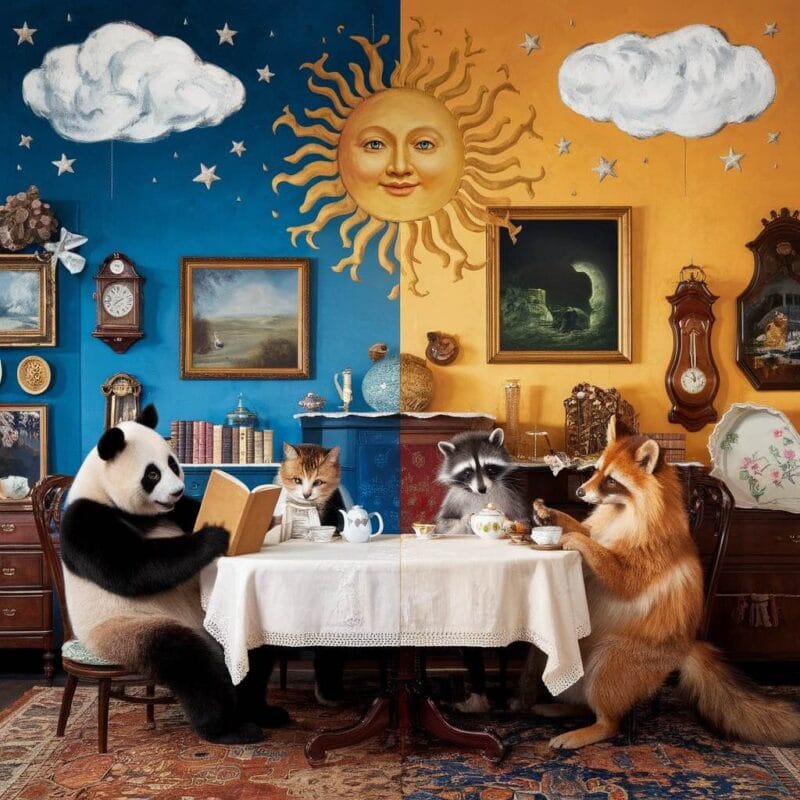
Anthropomorphism—the act of attributing human characteristics to non-human entities—has long been a potent tool in storytelling, but few mediums have wielded it with as much finesse as the comic series. When executed with precision, this narrative device transcends mere whimsy, evolving into a transformative force that reshapes audience perception, deepens thematic resonance, and carves out a distinct identity in an oversaturated market. The comic series that master this technique don’t just tell stories; they invite readers into a world where the boundaries between species blur, where inanimate objects breathe, and where emotions are not confined to human faces but radiate from the contours of a teapot’s handle or the slump of a tree’s branches. This is not mere decoration; it is a deliberate strategy to forge connections that linger long after the final panel is turned.
The Power of Personified Protagonists: When Objects and Animals Become Heroes
At the heart of many standout comic series lies a cast of protagonists who defy biological classification. These characters—whether they are sentient household appliances, anthropomorphic flora, or mythical beasts with human foibles—serve as more than mere vessels for plot progression. They become vessels for universal truths, their struggles mirroring human dilemmas while their perspectives offer fresh, often disarming insights. Consider the teapot that refuses to pour, its spout trembling with existential dread over its purpose in a bustling kitchen. Or the oak tree that watches centuries pass, its rings etched with the weight of unspoken secrets. These characters don’t just act; they embody.
By humanizing the inanimate or the non-human, creators tap into a primal human need: the desire to see ourselves reflected in the world around us. This reflection is not superficial. It is a mirror held up to our own vulnerabilities, our quests for meaning, and our battles against entropy. The comic series that excel in this arena don’t just anthropomorphize for novelty’s sake; they do so to illuminate the hidden narratives within the mundane. A sentient subway train, for instance, might grapple with the monotony of its daily route, its metallic body groaning under the weight of human indifference. Such a premise transforms a commuter’s frustration into a poignant allegory for modern alienation.
Visual Storytelling: The Art of Expressive Design in Anthropomorphic Comics
The magic of anthropomorphism in comics is not confined to narrative alone; it is a visual symphony where form and function intertwine. The design of anthropomorphic characters must strike a delicate balance—sufficiently human to evoke empathy, yet unmistakably non-human to retain intrigue. This is where the subtlety of line work, the curvature of a spine, or the tilt of an ear becomes a language of its own. A fox with a scholar’s spectacles conveys intellectualism without a single word. A clockwork crow with gears exposed for wings suggests both fragility and mechanical precision, a duality that mirrors the human condition.
Color palettes play an equally pivotal role. Warm hues might envelop a character to evoke approachability, while cool, desaturated tones could shroud another in melancholy. The contrast between a character’s physical form and their emotional state creates a visual tension that propels the reader forward. Imagine a storm cloud rendered in soft pastels, drifting across a page as it wrestles with its own volatility. The dissonance between appearance and emotion becomes a visual metaphor for internal conflict, a technique that transcends language barriers and speaks directly to the subconscious.
World-Building Through Non-Human Lenses: Crafting Societies from Scratch
Anthropomorphism isn’t limited to individual characters; it can redefine entire worlds. When a comic series populates its universe with non-human societies, it doesn’t just create a backdrop—it constructs a lens through which readers interrogate their own reality. A city of sentient books, where spines are streets and ink is currency, becomes a satire of consumerism and knowledge commodification. A forest where trees communicate through seasonal changes and root networks critiques the fragility of ecosystems and human exploitation.
The key to successful world-building lies in consistency. The rules governing these societies must be as rigorously defined as those in any human-centric narrative. What does justice look like in a world where laws are enforced by a council of bees? How does love manifest when the characters are constellations? These questions force creators to think beyond traditional frameworks, resulting in universes that feel both alien and intimately familiar. The best anthropomorphic worlds don’t just suspend disbelief—they invite readers to question what they’ve taken for granted all along.
Thematic Depth: Using Anthropomorphism to Explore Humanity’s Shadow
Beyond entertainment, anthropomorphism serves as a Trojan horse for profound themes. By distancing the narrative from human protagonists, creators can tackle sensitive topics with a veneer of detachment, only to reveal their relevance through the characters’ struggles. A comic series about a sentient AI might explore themes of identity and autonomy, while one featuring a grieving volcano could delve into the cyclical nature of destruction and rebirth. The non-human perspective acts as a buffer, allowing readers to engage with heavy subject matter without the immediate defenses that human-centric stories might trigger.
This thematic layering is often where the most memorable anthropomorphic comics distinguish themselves. A story about a lighthouse keeper who is, in fact, a lighthouse with a soul, might seem whimsical on the surface. Yet, beneath its lyrical prose and evocative imagery lies a meditation on isolation, purpose, and the quiet heroism of endurance. The non-human protagonist doesn’t dilute the theme; it amplifies it, offering a perspective that feels both intimate and expansive.
Reader Engagement: The Interactive Potential of Anthropomorphic Narratives
Anthropomorphism also unlocks unique avenues for reader engagement. Interactive comics, where the audience’s choices influence the fate of anthropomorphic characters, thrive on this device. A reader might guide a sentient door through a labyrinthine house, deciding whether to open or lock it at critical junctures. The stakes feel personal because the character’s form—its hinges, its creaks, its vulnerability—resonates on a tactile level. This tactile engagement fosters a deeper emotional investment, turning passive readers into active participants in the narrative.
Moreover, anthropomorphic comics often lend themselves to transmedia storytelling. A series about a clockwork city might expand into an animated short where the mechanical whirring of the characters’ movements becomes a soundtrack. A graphic novel about a river’s journey to the sea could inspire a companion podcast where the river itself narrates its experiences. The versatility of anthropomorphism allows creators to experiment with formats, ensuring the story’s reach extends beyond the page.
Cultural Resonance: Anthropomorphism as a Mirror and a Window
Anthropomorphism is not a universal constant; it is a cultural artifact, shaped by societal values, myths, and collective experiences. In some traditions, animals are revered as deities, while in others, objects are imbued with spiritual significance. A comic series that draws from these cultural wellsprings can achieve a resonance that transcends its medium. A tale of a fox spirit navigating the modern world might resonate deeply in East Asian cultures, where the fox is a symbol of both cunning and wisdom. Similarly, a story about a sentient compass lost in a city of shifting streets could evoke the existential dread of globalization, a theme familiar to urban dwellers worldwide.
This cultural specificity doesn’t limit the comic’s appeal; it enriches it. By grounding anthropomorphism in cultural context, creators invite readers to see their own traditions reflected in the narrative while also offering a window into unfamiliar worlds. The result is a storytelling experience that feels both deeply personal and universally relatable.
Conclusion: The Enduring Allure of the Non-Human
Anthropomorphism in comic series is more than a stylistic choice—it is a narrative revolution. It challenges creators to rethink the boundaries of storytelling, to find humanity in the unlikeliest of places, and to craft worlds that are as thought-provoking as they are visually stunning. The series that master this art form don’t just stand out; they redefine what it means to connect with an audience. They remind us that empathy is not the exclusive domain of our own species, and that the most profound stories are often those told by the quietest voices—whether they belong to a teapot, a tree, or a storm cloud drifting across a page.