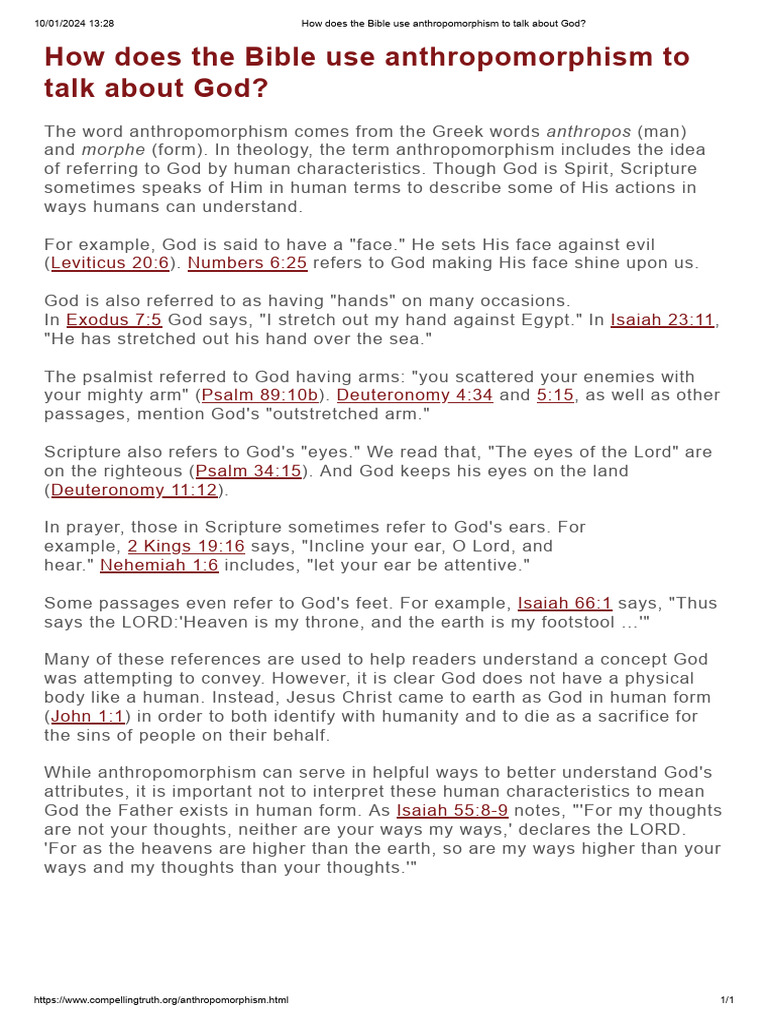
Anthropomorphism is a fascinating concept that permeates various realms of literature, art, and even theology. But what happens when we apply this whimsical lens to the divine? Can attributing human-like characteristics to God enhance our understanding of the divine, or does it confine the infinite? This playful inquiry leads us into the intriguing world of religious anthropomorphism, where the intentions and implications of such personifications unfold with remarkable richness.
To commence our exploration, we must first establish what anthropomorphism precisely signifies. Derived from the Greek terms “anthropos,” meaning human, and “morphe,” meaning form, anthropomorphism is the attribution of human traits, emotions, or intentions to non-human entities. This literary device is often found in fables and folklore—a clever fox may speak or a wise owl may dispense advice. However, when this device is applied to deities or spiritual concepts, it ventures into a unique theological territory.
In many religious texts, the portrayal of God exhibits distinctly human characteristics. The Abrahamic faiths—Judaism, Christianity, and Islam—often depict God with human-like emotions such as compassion, anger, and love. For instance, in the Hebrew Bible, God is frequently represented as a shepherd who cares for His flock. This image conjures a sense of intimacy and connection, inviting followers to cultivate a personal relationship with the divine. Such representations do not only enrich the narrative; they serve an essential psychological purpose, making the concept of God more relatable and accessible to human understanding.
However, this leads to the question: does anthropomorphism limit our perception of God? If God is depicted with human flaws and emotions, does this confine the divine essence to human understanding? Critics of anthropomorphic representations argue that they may diminish the transcendental nature of God. By attempting to conceptualize the Almighty in human terms, one risks reducing the divine to the constraints of human experience and logic.
Despite these criticisms, proponents of anthropomorphism posit that such humanization is not a diminishment but rather an essential avenue for understanding. They argue that employing human characteristics helps bridge the often intimidating gap between the finite and the infinite. A God portrayed as compassionate and just can inspire believers to emulate these virtues in their lives. Hence, the anthropomorphic figure serves as a pedagogical tool, guiding humanity toward spiritual growth.
In exploring the implications of religious anthropomorphism, we must also consider the role it plays across various cultures and religions. For instance, Hinduism is rich with anthropomorphic deities, such as Lord Krishna and Goddess Durga, who embody human-like traits and emotions. These personifications allow devotees to engage with the divine on an emotional level, encouraging acts of devotion and love. The narrative of these gods encompasses human experiences—joy, sorrow, and the quest for meaning—facilitating a deeper understanding of one’s own life circumstances.
Another perspective can be found in Buddhism, which tends to resist anthropomorphic depictions of the divine. The focus here is on enlightenment rather than divine personification. However, even within Buddhism, figures like the Bodhisattva may exhibit traits that resonate with human compassion and empathy. This blend showcases the complexity and diversity of anthropomorphic representation across spiritual traditions.
Now, let us turn our gaze towards the implications of anthropomorphism in contemporary society. In the age of technology and rapid advancement, the nature of human experience is evolving. As artificial intelligence becomes more integrated into our lives, anthropomorphic representations are increasingly prevalent. We assign personalities to virtual assistants and even attribute emotions to robots, fostering a connection that mirrors divine interaction.
This cross-pollination raises questions about the implications of anthropomorphism beyond religion. In a world where human-like machines and virtual entities play significant roles, how does our projection of human traits onto them affect our perceptions of humanity and our relationships with the divine? The lines separating the human, the divine, and the artificial become blurred, suggesting a need to reassess how we connect with both the tangible and the intangible.
In summary, religious anthropomorphism captivates the imagination and elicits profound reflections on the nature of the divine. By attributing human-like characteristics to God, believers can forge intimate connections that bring spirituality into the realm of everyday life. Yet, this process also invites scrutiny. Does it confine the divine to our narrow understanding, or does it facilitate personal comprehension and emotional resonance? The ongoing dialogue surrounding anthropomorphism underscores the richness of religious narrative and its relevance in contemporary society.
As we ponder these questions, it is essential to embrace the complexity of the divine. Whether through humanizing depictions or abstract concepts, the pursuit of understanding the sublime remains a central tenet of spiritual exploration. In this ongoing quest, let us celebrate the myriad ways we endeavor to connect with the divine, recognizing that every portrayal—be it anthropomorphic or otherwise—serves to illuminate the multifaceted essence of belief.