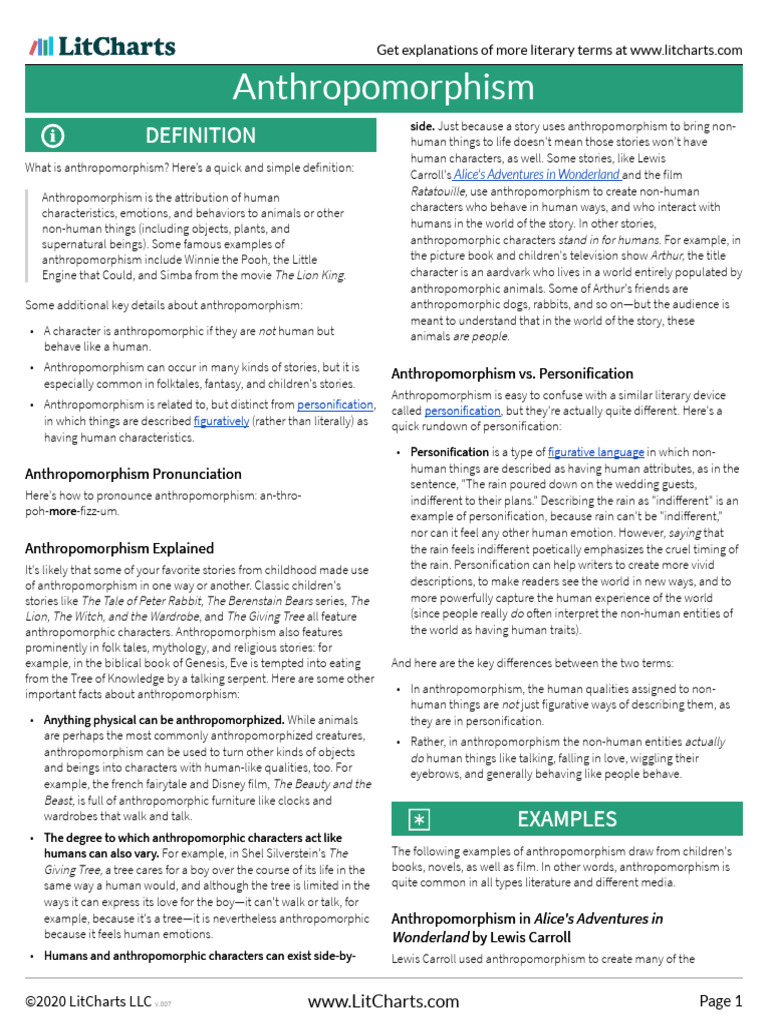
Anthropomorphism, derived from the Greek words “anthropos” meaning human and “morphe” meaning form, is a literary device that bestows human traits, emotions, and intentions upon non-human entities. This enchanting technique transcends mere anthropocentrism, inviting readers to explore realms where animals, objects, and even abstract concepts exhibit distinctly human characteristics. The allure of anthropomorphism lies not just in its capacity to engage the audience but also in its profound ability to evoke empathy, introspection, and social commentary.
At the heart of anthropomorphism is the art of creating relatable characters out of the inanimate and non-human. This literary maneuver serves various purposes, each as compelling as the last. On a basic level, it fosters connection. Readers, whether young or old, are often drawn to stories where familiar emotions resonate, even through the prism of a woodland creature or a poetic sunbeam.
Anthropomorphism deftly weaves itself into various genres, enriching narratives by layering complexity. In children’s literature, animals often take center stage, offering moral lessons couched in whimsy. Classic examples can be found in Aesop’s Fables, where cunning foxes and industrious ants illustrate virtues and vices. Through these stories, young minds navigate the complicated landscape of morality through easily digestible metaphors. The anthropomorphic characters serve not only as entertainment but also as frameworks for understanding interpersonal dynamics and ethical behavior.
In contrast to the simplicity often embraced in children’s tales, more sophisticated literature employs anthropomorphism to probe deeper societal issues. George Orwell’s “Animal Farm” exemplifies this, using farm animals to critique authoritarian regimes and the malleability of power. Here, the anthropomorphic pigs and their human counterparts navigate a complex world of ambition and betrayal. The reader is compelled to confront uncomfortable truths about societal structures and human nature, all through the lens of talking animals that cleverly eschew the boundaries of human behavior.
Moreover, anthropomorphism can animate the inanimate, turning everyday objects into protagonists with their own emotional trajectories. In literature, such objects often reflect the psyche of the characters that interact with them. Consider the extraordinary tale of “The Velveteen Rabbit” by Margery Williams, where a toy rabbit longs to become real through the love of a child. The poignancy of this narrative lies in its exploration of authenticity, love, and the transition from childhood innocence to the starkness of reality. The velveteen rabbit’s journey epitomizes the dogged pursuit of being understood and valued, mirroring the human condition.
Anthropomorphizing inanimate objects invites readers to reexamine their surroundings. The ordinary becomes extraordinary when imbued with the stories and emotions of their human counterparts. This technique can evoke nostalgia, tenderness, or humor, depending on the context. In the realm of poetry, works such as “The Highwayman” by Alfred Noyes breathe life into the landscape, making the setting almost a character in its own right, pulsating with the same fear and longing as the protagonists. Each shadow and moonlit glimmer relies on anthropomorphism to create an immersive experience where the environment is not just backdrop but a participant in the narrative.
The unique appeal of anthropomorphism is its ability to convey complex themes without overtly stating them, inviting readers into a dance of implication and reflection. This subtlety enables authors to craft narratives that resonate on multiple levels. For example, in works like “Watership Down” by Richard Adams, the anthropomorphism of rabbits extends beyond mere character development; it embodies intricate social structures and existential contemplation. Adams meticulously constructs a world that mirrors human society, complete with its complexities, fears, and hopes, while presenting a poignant commentary on resilience and community.
As an intriguing metaphor, anthropomorphism illuminates humanity’s connection to nature. It signifies an understanding that transcends words, tapping into the universal emotions that bind all living things. The use of anthropomorphic figures can instigate a profound dialogue about climate change and environmental issues. Authors can draw parallels between human actions and the lives of animals impacted by those actions, prompting readers to reevaluate their responsibilities toward the environment. In this way, anthropomorphic narratives become catalysts for change, fostering a deeper environmental consciousness among audiences.
Ultimately, the success of anthropomorphism in literature lies in its richness as a storytelling mechanism. It blurs the lines of reality, enticing readers to suspend disbelief and immerse themselves in fantastical realms. The transformative power of anthropomorphic characters encourages an empathetic connection that can transcend cultural and generational boundaries. They are not mere vessels of narrative but reflections of our own aspirations, fears, and ideals.
In conclusion, anthropomorphism emerges as a vital literary device that embellishes narratives with depth and meaning. From children’s fables to profound societal critiques, it serves as a versatile tool that connects readers to complex themes through the lens of familiar traits. This creative articulation of the non-human accentuates our intrinsic desire for connection and understanding. Hence, whether it be in the context of whimsical storytelling or earnest, reflective prose, anthropomorphism endows literature with the capacity to familiarize the foreign and render the estranged, intimate.